
The insulation strength of SF6 switchgear depends on gas density, not pressure. Here is why temperature-compensated density monitoring is essential, and how XINTE density relays deliver it reliably in the field.
The principle
SF6 gas provides the dielectric insulation inside GIS, circuit breakers and switchgear. Its insulating capability is governed by the number of gas molecules in the enclosure — i.e. the density.
A plain pressure gauge is misleading: in a sealed compartment the pressure rises and falls with ambient temperature even though no gas has leaked. Reading pressure alone, an operator cannot tell a real leak (lost gas) from a cold morning (lower pressure, same gas). A density relay removes temperature from the equation and reports the value that actually matters for insulation — referenced to 20 °C.
See density relay range →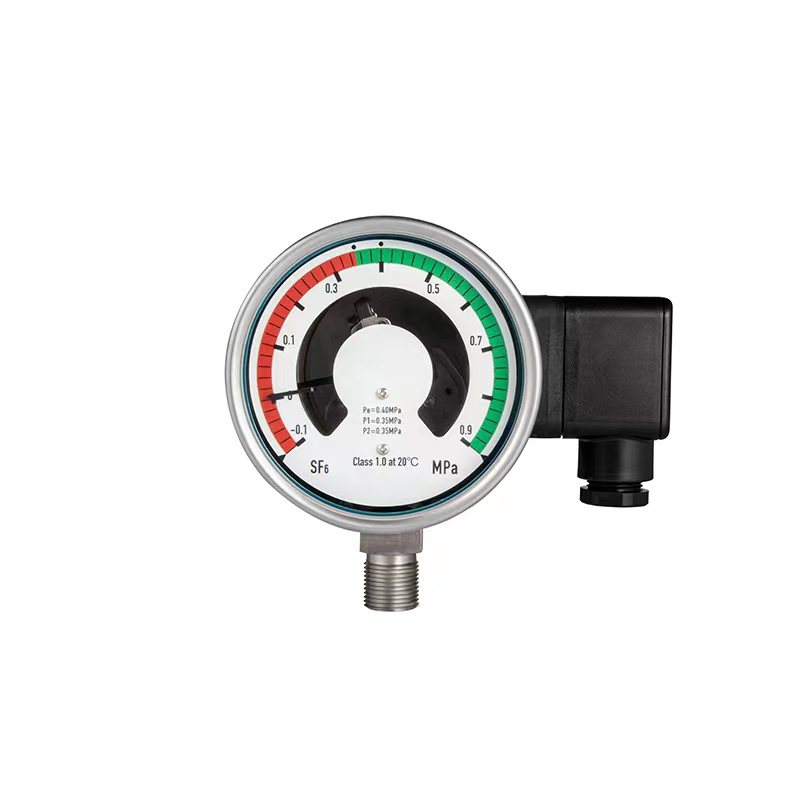
Temperature compensation
XINTE density relays measure pressure with a sensing element and mechanically compensate for temperature, so the indicated density is independent of ambient conditions from −40 °C to +60 °C.
An imported Bourdon tube converts the SF6 gas pressure into a precise mechanical movement.
A temperature-sensitive bimetal element corrects the movement so that thermal expansion of the gas is cancelled out.
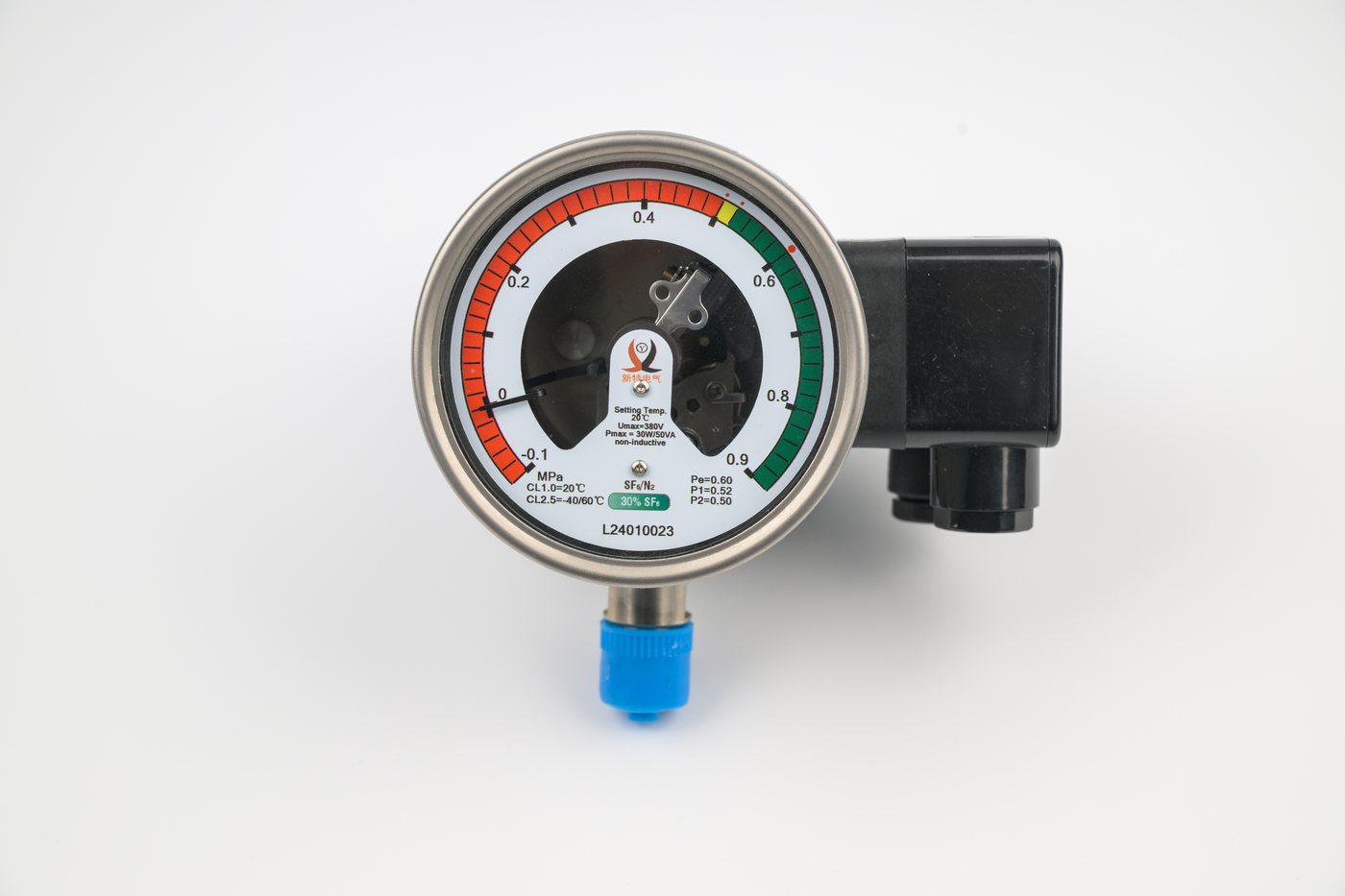
The dial and contacts respond to true gas density (P₂₀), so an alarm means real gas loss — not a temperature swing.
Interactive demo
Drag the temperature. The ordinary pressure gauge drifts with the weather — the XINTE density relay holds the true gas value. Then simulate a slow leak and watch the alarm logic respond.
Rated density 0.60 MPa (referenced to 20 °C) · Alarm P1 = 0.52 MPa · Lockout P2 = 0.50 MPa. Simplified model for illustration.
Protection logic
Density relays carry up to three magnetic-assisted contact pairs that trip at preset density set-points to protect the equipment as gas is slowly lost:
Reliability by design
A density relay only protects equipment if it stays accurate and leak-free for decades in a harsh electromagnetic and climatic environment. Every XINTE relay is engineered and tested for it.
Leakage rate ≤ 1×10⁻⁸ Pa·m³/s — the device itself never becomes a leak path.
Verified immunity to ESD, RF, fast transients and surges around HV switchgear.
>100 MΩ insulation (DC 500 V); 2 kV / 1 min withstand (3 kV on MJ100L).
Sealed stainless case for outdoor service; MJ100L rated to −60 °C.
Selection guide
| If you need… | Choose |
|---|---|
| Local indication + alarm/lockout contacts (Ø100) | MJ100 / MJ100L (ultra-low temp) |
| The same, in compact Ø64 for RMU / MV switchgear | MJ60 |
| Live density data to SCADA (RS-485 / Modbus) | MJR100 |
| Density + SF6 moisture (micro-water) monitoring | MJR100W |
| Digital local display with remote output | MJS100 |
| Purely mechanical indication, no contacts | M60 density meter |
Send us your equipment, rated density, alarm/lockout points and protocol — our engineers will recommend the right model and quote within 24 hours.